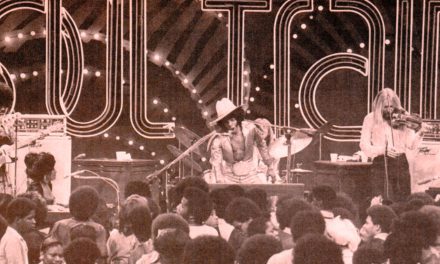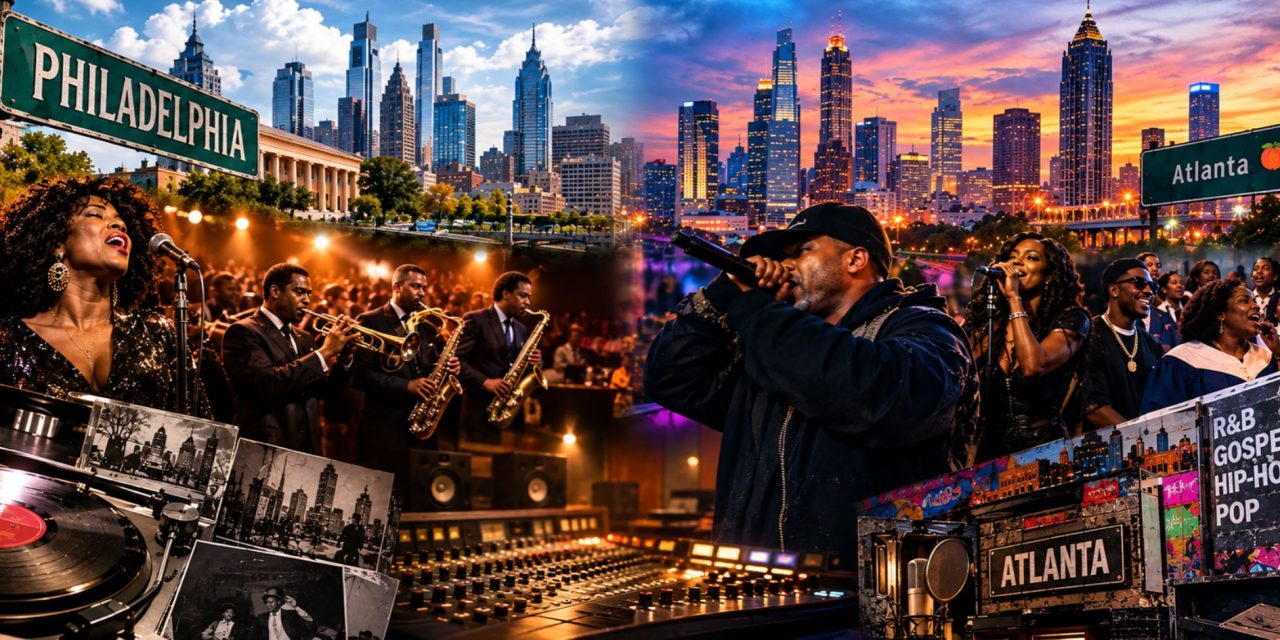
Philadelphia and Atlanta may have shaped soul music in very different eras, but both cities turned local musical traditions into national movements.
Philadelphia built the lush, orchestral Philly soul sound of the 1970s through labels, studios, musicians, and producers working closely together. Decades later, Atlanta became a major R&B center through labels like LaFace, combining gospel-rooted vocals with hip-hop production and modern songwriting.
Their stories show how a city’s musical identity grows from more than hit records. Studios, neighborhoods, churches, producers, and creative communities all help determine what a city’s sound becomes.
Philadelphia: The Sound of Brotherhood
Philadelphia International Records, founded in 1971 by Kenny Gamble and Leon Huff, became the home of the sophisticated Philly soul sound. The label worked with artists including The O’Jays, Harold Melvin & the Blue Notes, Billy Paul, Teddy Pendergrass, Patti LaBelle, and Lou Rawls.
The city’s musical identity was built around lush strings, driving rhythms, gospel influence, and carefully arranged vocals. A core group of Philadelphia musicians helped create the polished sound that became one of the defining styles of 1970s soul.
Social message lyrics became an important part of that identity. Songs such as The O’Jays’ “Love Train” carried messages of unity while still functioning as irresistible dance records. The song reached number one on both the Billboard Hot 100 and R&B chart in 1973.
Philadelphia’s wider community also mattered. The city’s clubs, neighborhoods, churches, and local musicians created an environment where new grooves could develop before reaching national audiences. The result was a sound that felt polished without losing its connection to the people who created it.
Gamble & Huff’s Philly Sound
Kenny Gamble and Leon Huff became central architects of the Philadelphia sound. Their songwriting and production partnership helped define Philadelphia International Records and gave the city a distinctive musical identity during the 1970s.
Their approach combined steady rhythm sections with lush orchestral arrangements. Thom Bell and other arrangers and musicians expanded the sound, while the house musicians associated with Sigma Sound helped give the recordings their recognizable groove.
The O’Jays’ “Love Train” became one of the clearest examples of what the formula could accomplish. Written and produced by Gamble and Huff, the song turned a message about worldwide unity into a major dance hit. It spent four weeks at number one on the R&B chart and reached number one on the pop chart.
That combination became one of Philly soul’s greatest strengths. The music could make you dance while still giving you something to think about.
Sigma Sound Studios Legacy
Sigma Sound Studios became another essential part of Philadelphia’s musical identity. Founded by recording engineer Joseph Tarsia in 1968, the studio operated at 212 North 12th Street and became closely associated with Philadelphia International Records and the wider Philly soul movement.
The studio started as an eight-track facility before expanding into more advanced multitrack recording. By the early 1970s, Sigma had become a major destination for Gamble and Huff, Thom Bell, MFSB, and the artists who helped define Philadelphia soul.
Records including The O’Jays’ “Love Train,” Billy Paul’s “Me and Mrs. Jones,” MFSB’s “TSOP (The Sound of Philadelphia),” and The Spinners’ “I’ll Be Around” were connected to the studio.
Sigma’s legacy eventually became part of Philadelphia’s official history. The building received a Pennsylvania historical marker in 2015 and was later recognized by the Philadelphia Historical Commission.
Atlanta: Southern Soul Renaissance
Atlanta emerged as a major modern R&B center decades after Philadelphia’s golden era. By the 1990s, the city had developed an increasingly powerful music infrastructure, with labels, producers, studios, and artists helping create a distinctly Southern sound.
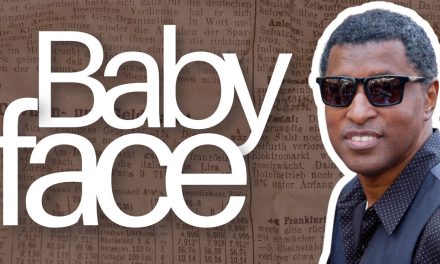
LaFace Records became central to that transformation. Founded in Atlanta in 1989 by Antonio “L.A.” Reid and Kenneth “Babyface” Edmonds, the label helped establish the city as a major center for R&B, hip-hop, and pop.
The label’s roster eventually included TLC, Toni Braxton, Usher, OutKast, Goodie Mob, and other major artists. Their success helped Atlanta earn comparisons to earlier music-industry centers, with the New Georgia Encyclopedia describing LaFace as an important force in establishing Atlanta’s reputation as a new Motown.
Atlanta’s musical identity also grew from the city’s older traditions. Gospel, soul, funk, and R&B had deep roots in Georgia, and those influences continued to shape newer generations even as hip-hop and programmed production became increasingly important.
LaFace Records & TLC
LaFace’s success with TLC demonstrated just how powerful that combination could become.
The label’s 1990s production system brought together strong songwriting, vocal harmonies, hip-hop influences, and polished studio production. TLC’s CrazySexyCool, released in 1994, became one of the defining albums of the decade and eventually achieved Diamond certification.
“Waterfalls“ became one of the clearest examples of Atlanta’s ability to combine commercial appeal with serious subject matter. The song spent seven weeks at number one on the Billboard Hot 100 while addressing issues including drug abuse and HIV/AIDS.
Its success reflected something important about Atlanta’s emerging sound. Smooth vocal arrangements and accessible production could carry difficult stories without sacrificing groove.
LaFace also helped establish a broader Atlanta creative network. Artists such as OutKast, Usher, Goodie Mob, and Toni Braxton expanded the city’s influence across R&B, hip-hop, and pop.
Tyler Perry’s Cultural Influence
Atlanta’s creative identity eventually expanded beyond music into a much broader Black entertainment ecosystem.
Tyler Perry’s decision to establish Tyler Perry Studios at the former Fort McPherson military base became an important example of that expansion. Perry purchased the 330-acre property in 2015, and the studio developed into a major production campus with 12 purpose-built soundstages.
The studio’s 2019 grand opening highlighted Atlanta’s growing importance as a home for Black creative production. Its stages were named after influential Black figures across entertainment, including Cicely Tyson, Denzel Washington, Halle Berry, Sidney Poitier, and Oprah Winfrey.
While Tyler Perry Studios is primarily a film and television facility rather than a soul-music institution, its presence reflects something important about Atlanta’s broader cultural evolution. The city increasingly offered Black creators the infrastructure to develop, produce, and own major creative projects without automatically leaving the region.
That same spirit connects with Atlanta’s musical history. Cultural memory does not stay frozen in one genre or generation. It moves through new institutions, new artists, and new forms of creative expression.
Conclusion
Philadelphia and Atlanta built their musical identities in different eras, but both demonstrate how powerful a city can become when its creative communities have the space to grow.
Philadelphia gave soul music the orchestral elegance, rhythmic drive, and social consciousness of the Philly sound. Atlanta later built a new Southern music infrastructure where R&B, gospel, hip-hop, and pop could develop side by side.
The lesson is bigger than either city. A music scene becomes a movement when the people, places, and institutions around the music start pushing in the same direction.
If you could spend one night inside either city’s musical history, would you take the Philly soul train of the 1970s or Atlanta’s R&B explosion of the 1990s?
Whichever one you choose, DLK Soul has plenty more stories waiting where music, cities, and culture meet.