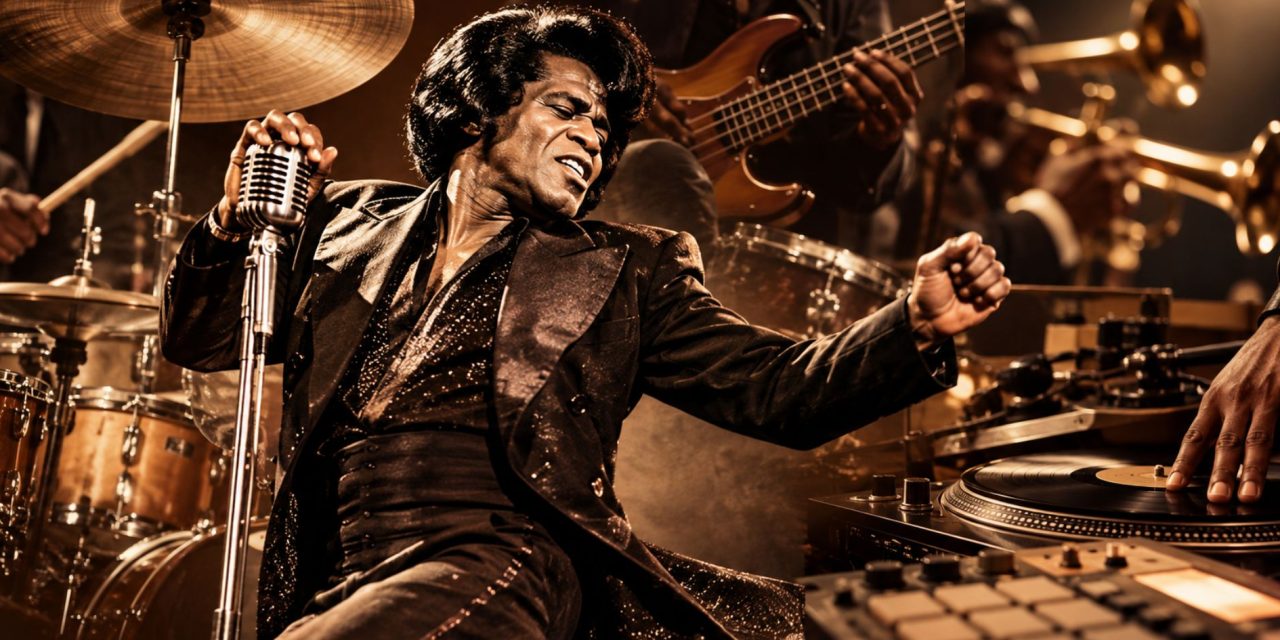
James Brown didn’t just play the drums. He changed how rhythm could function inside popular music.
The tight beats, sparse arrangements, and relentless grooves he developed continue to appear in modern productions. Funk absorbed them first, while hip-hop later found new possibilities inside Brown’s breaks.
His recordings gave producers something remarkably useful: rhythmic parts that could stand alone. A drum break could become a loop, while a bass line could provide the foundation for an entirely new track.
Brown’s influence therefore reaches beyond nostalgia. His rhythmic ideas remain practical tools for musicians, producers, DJs, and beatmakers working decades after his most influential recordings.
The Groove Blueprint That Connected Soul, Funk, and Hip-Hop
Between 1964 and 1969, Brown transformed R&B’s familiar 2/4 backbeat into the one-drop rhythm that became central to funk.
His 1965 recording Papa’s Got a Brand New Bag marked a decisive shift. Instead of relying on dense soul arrangements, the track emphasized sparse, propulsive rhythms and a tighter ensemble pocket.
Recordings from this period typically sat between 95 and 108 BPM. Those tempos gave the groove room to breathe while maintaining enough drive for the dance floor.
The JB’s provided the ensemble tightness that made this approach work. Repetition and space became more important than constant chord changes.
Brown’s approach also placed greater emphasis on beat one while retaining syncopated offbeat accents. This created the on-the-one feel that became one of funk’s defining characteristics.
The rhythmic blueprint eventually reached beyond funk. Producers could isolate breaks, reuse drum patterns, and build entirely new compositions around Brown’s timing.
That flexibility helps explain why his recordings became such valuable source material for hip-hop. His grooves already contained many of the rhythmic spaces that later producers needed.
1. Key Rhythmic Innovations
Brown’s rhythmic approach depended on several elements working together rather than one isolated trick.
The bass and kick often landed together on beat one with minimal variation. The opening of Cold Sweat provides a clear example of this approach.
The guitar added another layer through its chicken scratch pattern. Its 16th-note syncopation pushed against the downbeat without overwhelming the groove.
The horn section then created another rhythmic conversation. Horn punches landed on the and of beat one and the and of beat four, producing staggered call and response.
The first eight bars of Cold Sweat demonstrate these elements in sequence. Around 0:00, the kick and bass establish beat one before the guitar fills the offbeats.
Horn stabs then reinforce the shifted accent structure. Each instrument occupies a defined rhythmic space, keeping the arrangement sparse without making it feel empty.
That balance became crucial to Brown’s sound. The groove feels grounded because of its strong pulse, yet remains alive because of its syncopation.
The same principle later became useful to hip-hop producers. A rhythm with clearly separated parts can be sampled, rearranged, chopped, and rebuilt without losing its character.
2. Signature Drum Patterns
Clyde Stubblefield’s 1969 performance on Funky Drummer became one of the clearest examples of this approach. The recording’s 16-bar break eventually became foundational source material for hip-hop production.
Stubblefield’s pattern balances strong downbeats with subtle subdivisions. The kick lands on beat one and the and of two, while the snare emphasizes two and four.
Ghost notes fill the 16th-note subdivisions between the primary accents. Steady eighth-note hi-hats maintain the pulse, while the opening on the and of four adds movement into the following bar.
The combination creates a pocket that feels precise without becoming rigid. There is enough space for other musical elements to enter without competing with the drums.
Jabo Starks took a different approach on Sex Machine. His pattern favors a tighter eighth-note feel, with less subdivision in the snare hand.
Both approaches sit around 102 BPM. That tempo provides enough breathing room for the groove while retaining strong dance-floor energy.
The original Funky Drummer recording contains an isolated break between approximately 1:15 and 1:35. That passage later became one of the most sampled sections in music history.
Producers could use the complete break or extract individual drum hits. Either approach preserved some of the original timing and feel while allowing new musical ideas to develop around it.
This is where Brown’s influence becomes particularly important for modern production. His grooves were not simply successful recordings from another era.
They were flexible rhythmic frameworks.
A producer could sample them directly, imitate their patterns, or adapt their underlying ideas to new instruments and technologies. That ability to survive reinterpretation is a major reason Brown’s rhythmic blueprint continues to surface across contemporary music.
Conclusion
James Brown’s lasting influence is rooted in rhythm rather than a single sound or recording. His approach to beat one, syncopation, repetition, space, and ensemble interaction changed what a groove could accomplish.
Funk developed those ideas into a new rhythmic language, while hip-hop later found another use for the breaks and patterns Brown’s musicians created.
That connection makes his work useful as a starting point for understanding several musical movements. The important story is not simply that later artists sampled Brown.
It is that they found something structurally powerful enough to rebuild in their own musical worlds.
Have you ever recognized an old-school groove in a song released years later? DLK Soul traces the musical ideas that keep finding their way into new sounds.