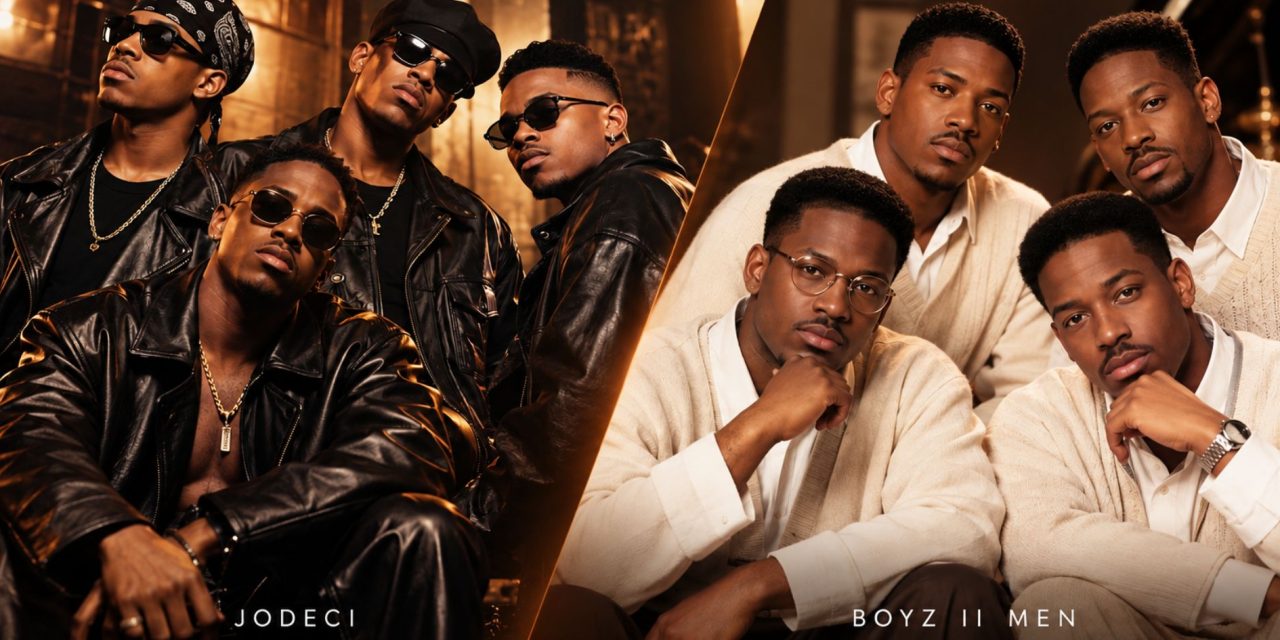
Picture two powerhouse groups owning the 90s airwaves while making listeners feel almost everything. One brought leather, attitude, and raw desire. The other arrived with matching shirts, flawless harmonies, and enough emotion to break a heart politely.
Did you know Jodeci and Boyz II Men both had gospel roots, yet took remarkably different routes through 90s R&B? Their contrasting styles helped define the decade’s romantic sound.
From their origins and breakthrough moments to their production choices and visual identities, both groups left distinct marks. Their stories also explain why fans still debate their approaches to R&B emotion today.
Two Gospel Roots, Two Very Different R&B Journeys
Jodeci and Boyz II Men emerged from church backgrounds between 1989 and 1991. Their gospel foundations shaped the emotional delivery that became central to their secular music.
Church performances taught both groups how to connect with audiences personally. That experience translated naturally from sacred spaces into recording studios and concert stages.
Record labels also recognized their unusual vocal chemistry and individual personalities. Uptown and Motown each saw opportunities within the rapidly changing 90s R&B landscape.
Yet their artistic directions quickly separated.
Jodeci leaned into a street-infused version of new jack swing. Their sound carried gritty sensuality, hip-hop influence, and unfiltered romantic tension.
Boyz II Men followed a smoother path built around gospel-trained vocals and polished quartet harmonies. Their ballads emphasized vulnerability, romance, and carefully blended voices.
That difference became one of the decade’s most interesting R&B contrasts. Both groups could make listeners emotional, but they rarely took the same route there.
1. Jodeci: Raw Passion Meets Bad-Boy Swagger
Did you know Jodeci’s breakthrough began with a demo that eventually reached Uptown Records founder Andre Harrell?
The group signed with Uptown Records in 1990 after submitting their demo. Their breakthrough single Come and Talk to Me later topped the Billboard R&B chart for two weeks in 1992.
DeVante Swing quickly established himself as the group’s production force. K-Ci Hailey and JoJo Hailey handled the lead vocals with unmistakable intensity.
Mr Dalvin completed the quartet alongside DeVante Swing. Together, they created a sound that felt deliberately different from polished mainstream R&B groups.
Their debut album, Forever My Lady, eventually achieved triple-platinum status. Its success helped establish Jodeci as one of the defining groups of early-90s hip-hop soul.
Their image was just as memorable as their music.
Leather, bandanas, and unmistakable bad-boy swagger became part of Jodeci’s identity. Their appearance matched the sensual edge running through their slow jams.
Their first appearance on MTV Yo! MTV Raps further introduced that image to wider audiences. Jodeci also earned their first Soul Train Award nomination in 1992.
Their combination of new jack swing, hip-hop influence, and intimate production became their calling card. The result was R&B that sounded emotional without trying to sound polished.
2. Boyz II Men: Polished Harmony and Heartfelt Emotion
Did you know Boyz II Men were discovered by Michael Bivins of Bell Biv DeVoe in 1989? The group was actually discovered at Philadelphia’s High School for the Creative and Performing Arts. They later released Motownphilly in 1991 and quickly became a major force in R&B.
Nathan Morris, Wanya Morris, Shawn Stockman, and Michael McCary formed the group’s distinctive vocal blend. Their debut album, Cooleyhighharmony, sold millions of copies and established them as harmony specialists.
Unlike Jodeci’s street-oriented image, Boyz II Men presented a cleaner appearance. Button-down shirts and matching outfits became part of their early visual identity.
Their sound followed the same polished direction.
Did you know End of the Road held the Billboard Hot 100 number-one position for 13 weeks in 1992? That achievement helped cement their place among the decade’s biggest romantic groups.
Early appearances on BET Video Soul also helped introduce their music to wider audiences. Their first Grammy win came in 1992 for Best R&B Performance by a Duo or Group.
Motown provided a major platform for their vocal range and emotional depth. Their songs frequently featured lush production, string arrangements, and carefully layered harmonies.
Romantic ballads became a defining part of their identity. Their gospel-trained vocals allowed them to turn heartbreak and devotion into songs that felt deeply communal.
Where Jodeci made romantic tension feel raw, Boyz II Men made vulnerability feel beautifully controlled. Both approaches connected with listeners, but each group occupied a different emotional corner of 90s R&B.
Conclusion
Jodeci and Boyz II Men proved that emotional R&B did not need one formula. Their shared gospel foundations gave them a common starting point, but their artistic choices took them in different directions.
Jodeci brought street energy, sensuality, and hip-hop soul into the spotlight. Boyz II Men centered polished harmonies, romantic ballads, and vocal precision.
That contrast helped make 90s R&B such a memorable era. One group could make you feel the tension, while the other could make you reach for tissues before the second chorus.
Which side of 90s R&B emotion still speaks to you more: raw passion or polished harmony?
DLK Soul revisits the sounds, stories, and emotions that made both approaches unforgettable.