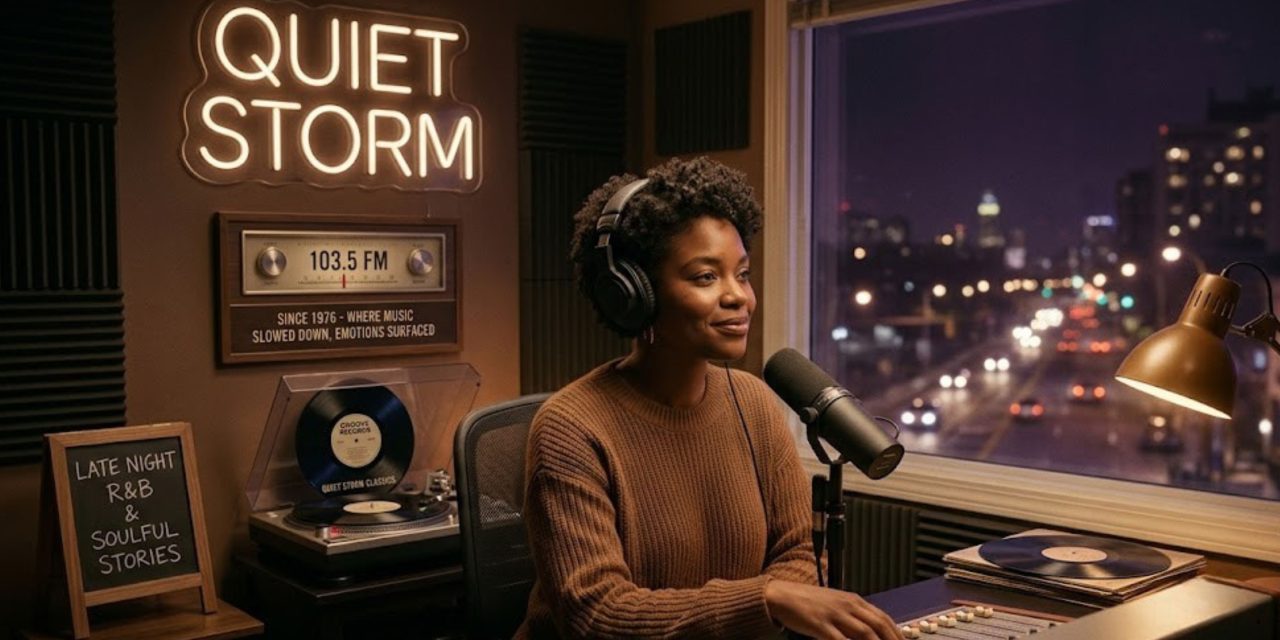
Before playlists promised “late-night vibes” and streaming apps started curating heartbreak by algorithm, radio already had the formula perfected.
Somewhere between midnight thoughts, dim lights, and one too many “you up?” moments, Quiet Storm found its audience. What started as an experimental radio slot in 1976 became something far bigger—a sanctuary for grown R&B lovers, night owls, romantics, and anyone who needed music that understood the mood without saying too much. Quiet Storm did not just play slow jams. It turned late-night radio into an emotional ritual.
From its roots at Howard University’s WHUR-FM to its lasting influence on modern R&B programming, Quiet Storm changed how listeners experienced music after dark.
Origins of the Quiet Storm Format
The Quiet Storm radio format began as a three-hour Sunday night show at WHUR-FM. Programmers needed content to fill what was essentially a dead slot—weekend nighttime radio that attracted almost no audience. December 1976 marked the official launch of the format on WHUR 96.3 in Washington, D.C.
The show ran from 7 to 10 p.m. and targeted listeners seeking romantic R&B after hours. Station staff built a playlist around slow grooves, soft production, and sensual vocals. The initial rotation featured roughly 30 songs pulled from classic soul and bedroom-R&B favorites.
Management simply wanted to keep the station alive during low-traffic hours. They leaned into mellow grooves and intimate lyrics to create something different from daytime radio. What started as a practical scheduling solution soon became one of Black radio’s most influential formats.
Listeners responded immediately. The soft beats and heartfelt vocals created a calm, deeply personal atmosphere. Quiet Storm offered a gentle alternative to fast-paced daytime programming, and its influence quickly spread to stations nationwide.
Birth at WHUR in 1976
Cathy Hughes, WHUR’s program director, approved the Quiet Storm slot after noticing poor Sunday-night ratings in Arbitron’s fall 1976 report. The three-hour block gave the station room to experiment without disrupting weekday programming.
The very first song played was Quiet Storm by Smokey Robinson—a fitting choice that would ultimately give the format its name.
Initially, the show relied on reel-to-reel automation with no live DJ until 1977. Staff loaded the tapes, set the music, and let the mood carry itself. Surprisingly—or perhaps not—the format quickly caught fire.
The station’s Nielsen share jumped from 2.4 to 6.1 in just six weeks.
That leap proved something important: listeners were hungry for sophisticated, grown-up R&B during quiet evening hours. Suddenly, late-night radio had real commercial value.
Programmers kept the format focused on romantic ballads, tender soul cuts, and emotionally rich performances. Talk-heavy segments were kept to a minimum. The music did the heavy lifting.
Influence of Melvin Lindsey
Melvin Lindsey became the defining voice of Quiet Storm. At just 21 years old, the radio student hosted the first broadcasts with a smooth baritone delivery and remarkable restraint.
His talk breaks averaged only about twelve words.
That restraint became his magic.
Lindsey understood that Quiet Storm was not about talking over the music—it was about guiding the mood. His voice acted like a soft hand on the shoulder, gently moving listeners through each set without breaking the atmosphere.
He famously placed actual candles in the studio during broadcasts to help create the intimate feeling he wanted to project. He also read personal dedications written on 3×5 index cards sent by listeners each week.
The station received between 40 and 60 calls per hour during his shifts. Many callers requested slow jams for anniversaries, reconciliations, late-night confessions, or simply to say what words could not.
Lindsey remained at WHUR until 1986, helping shape Quiet Storm into a cultural institution. His understated style became the blueprint for future late-night R&B DJs.
Even today, his influence is everywhere—from slow-jam radio blocks to curated streaming playlists labeled “midnight soul,” “late-night R&B,” or “after-dark vibes.”
Conclusion
Quiet Storm was never just another radio format. It became a space where music slowed down, emotions surfaced, and listeners felt understood.
It transformed late-night radio into something intimate and unforgettable.
Through soft-spoken hosting, carefully curated playlists, and emotionally rich music, Quiet Storm gave grown R&B a home. It helped shape how generations connected with love songs, slow jams, and soulful storytelling—and its influence still lives on long after the final broadcast faded into the night.
Quiet Storm proved one thing: sometimes the softest voices leave the deepest impact. And we are only scratching the surface.
Coming up, we will dive deeper into the unforgettable slow jams, legendary dedications, and iconic artists that turned Quiet Storm into a late-night institution. Keep your dial locked to DLK Soul!