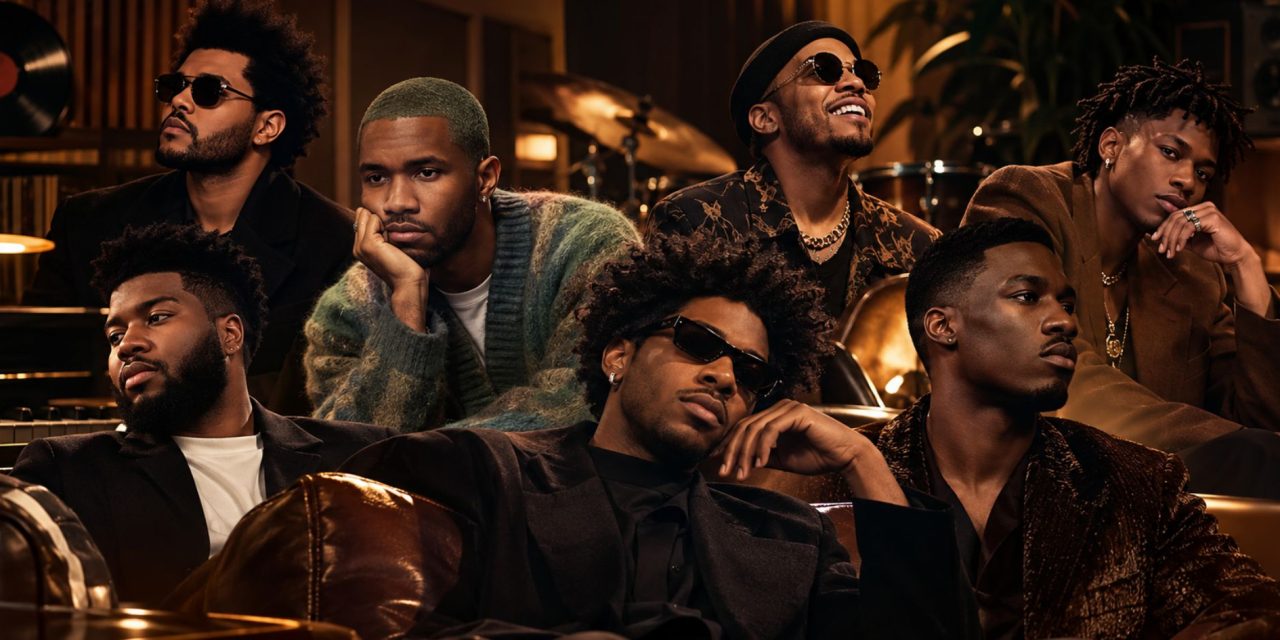
R&B has always had room for the smooth operator, but today’s version comes with more emotional honesty.
The modern male R&B artist can be vulnerable without losing swagger, experimental without abandoning melody, and polished without sounding overly manufactured.
That shift did not appear overnight. Artists such as Frank Ocean, The Weeknd, Miguel, and Anderson .Paak helped widen the genre’s emotional and sonic boundaries. Newer voices including Brent Faiyaz, Giveon, Lucky Daye, and others continue pushing those ideas forward.
Call it the New Gentleman Era if you like. The bigger story is how contemporary R&B keeps finding new ways to make confidence and vulnerability share the same room.
Pioneering Voices
Before the current wave of smooth voices and late-night playlists, several artists were already changing what male vulnerability could sound like.
Frank Ocean’s Channel Orange and Blonde made introspection feel expansive rather than confessional for confession’s sake. His writing moves between romance, memory, desire, identity, and uncertainty without forcing everything into neat emotional boxes. Blonde is widely classified as alternative R&B and alternative singer-songwriter music, reflecting just how far Ocean stretches the genre’s boundaries.
The Weeknd took a very different route. House of Balloons wrapped bruised vocals, dark production, seduction, and emotional turmoil into a distinctly atmospheric form of alternative R&B. Its sound helped establish a mood that could feel intimate, unsettling, and hypnotic at once.
Miguel brought sensuality and musicianship into the conversation through projects such as Kaleidoscope Dream. The album reached No. 3 on the Billboard 200, while “Adorn” earned him his first GRAMMY for Best R&B Song.
Then there is Anderson .Paak, whose music brings live instrumentation, funk, soul, hip-hop, and R&B into the same conversation. His breakthrough album Malibu reached No. 5 on Billboard’s R&B Albums chart and earned him two GRAMMY nominations.
The Blueprint
| Artist | Defining Release | Contribution to Modern R&B |
| Frank Ocean | Blonde | Expansive songwriting and emotional vulnerability |
| The Weeknd | House of Balloons | Dark, atmospheric alternative R&B |
| Miguel | Kaleidoscope Dream | Sensual songwriting and genre experimentation |
| Anderson .Paak | Malibu | Live instrumentation, funk, soul, and hip-hop fusion |
| Tinashe | Nightride | Atmospheric contemporary R&B and intimate slow jams |
| Jhené Aiko | Souled Out | Dreamy melodies, introspection, and understated vocals |
The blueprint extends beyond the men usually placed at its center. Tinashe’s Nightride leans into wispy slow jams, desire, and nocturnal atmosphere, while Jhené Aiko’s Souled Out blends contemporary R&B with introspection and subdued vocal delivery.
Together, these artists helped make space for R&B that could be sensual, strange, vulnerable, experimental, and still unmistakably melodic.
That matters because today’s male R&B artists are not starting from scratch. They are picking up a much larger creative palette.
Rising Stars
The newer guard is taking that palette somewhere sleeker, moodier, and sometimes considerably messier.
Brent Faiyaz has become closely associated with the darker, minimalist side of contemporary R&B. His WASTELAND era continued the tension between romance, ego, detachment, and vulnerability that has become central to his music.
Giveon brings a different kind of drama. His deep, resonant voice gives heartbreak songs a weight that feels almost theatrical, while his restrained delivery keeps them from becoming overly sentimental.
Khalid operates from a more conversational space. His music often turns ordinary experiences, young relationships, uncertainty, and growing pains into accessible R&B and pop songs.
Lucky Daye brings another ingredient: musicianship. His work draws from classic soul and contemporary R&B while allowing intricate arrangements, rhythmic changes, and strong vocal performances to remain central.
Tems expands the conversation even further through her low-register vocals, atmospheric production, and connections between R&B, Afrobeats, and global pop. Cleo Sol similarly favors warmth, restraint, spirituality, and deeply personal songwriting over flashy production.
The New Guard
| Artist | Standout Release | Defining Quality |
| Brent Faiyaz | WASTELAND | Minimalist trap-soul and emotional tension |
| Giveon | Give or Take | Deep vocals and reflective heartbreak |
| Khalid | American Teen | Conversational songwriting and youthful emotion |
| Lucky Daye | Painted | Classic soul influences and modern R&B |
| Tems | For Broken Ears | Atmospheric vocals and R&B-Afrobeats fusion |
| Cleo Sol | Why Don’t You | Warm, intimate songwriting and understated soul |
These artists do not all sound alike, and that is exactly the point.
Brent Faiyaz can make emotional distance sound seductive. Giveon can make heartbreak feel enormous with surprisingly little vocal excess. Lucky Daye brings technical musicianship into modern soul, while Cleo Sol favors warmth and space.
Even the broader R&B landscape reflects this appetite for fusion. GRAMMY coverage has highlighted the continuing movement between R&B, soul, funk, hip-hop, and other styles rather than treating the genre as a fixed sound.
The result is an R&B scene where polished production can sit beside live instrumentation, deep vocals can meet falsetto runs, and vulnerability can coexist with confidence.
And perhaps that is what makes this new wave interesting. The modern gentleman does not need to choose between tenderness and swagger.
He can bring both to the same song.
Conclusion
The story of modern male R&B is not really about replacing one generation with another. It is about watching ideas travel, mutate, and come back wearing different clothes.
Frank Ocean opened doors for unusual storytelling. The Weeknd pushed atmosphere and darkness into the mainstream. Miguel fused sensuality with experimentation, while Anderson .Paak proved that live musicianship still has plenty of room in contemporary R&B.
The artists following them are taking those lessons somewhere personal. Their voices, production choices, rhythms, and approaches to vulnerability are helping shape what the next chapter of R&B sounds like.
What happens when R&B’s smoothest voices stop hiding behind the cool? DLK Soul gets into the artists turning vulnerability, swagger, and soul into the sound of a new generation.